
 (619) 230-0330

San Diego Construction Accident Attorneys
San Diego Construction Accident Lawyer Helping Injured Workers Recover Compensation
Please note: Banker’s Hill Law Firm represents injured construction workers in workers’ compensation and third-party injury claims. We do not practice employment law and cannot assist with matters such as wrongful termination, wage-and-hour or prevailing-wage disputes, discrimination, or retaliation.
Our San Diego construction accident lawyers know that construction is one of the most dangerous industries in the country, and a single jobsite accident can end a career or a life. If you were hurt building San Diego (on a high-rise, a road project, or a residential site) you may have more than one way to recover. Our San Diego construction accident attorneys handle both sides of these cases: the workers’ compensation claim against your employer’s insurer and the third-party personal injury claim against anyone else whose negligence caused your injury.
This page explains how those two paths work in California, who can be held liable, the deadlines, and what your case may be worth. To speak with a construction accident lawyer in San Diego now, call (619) 230-0330 for a free consultation.
Proven Track Record
Our Injury and Workplace Case Results
These are examples of results our firm has obtained for injured clients across personal injury and workplace injury cases. When injuries happen on a jobsite, we hold negligent contractors, property owners, and employers accountable.
Additional Results
Past results do not guarantee a similar outcome. Every case is unique and depends on its individual circumstances. Results may vary based on the specific facts of your case.
Get Your Free EvaluationTwo Ways to Recover: Workers’ Comp vs. a Third-Party Claim
Most injured construction workers can pursue two separate types of recovery at the same time. Understanding the difference is the single most important part of maximizing what you receive.
1. Workers’ compensation (against your employer)
Workers’ compensation is a no-fault system: you receive benefits regardless of who caused the accident, but it is also your exclusive remedy against your employer under Labor Code section 3602. Benefits include medical treatment, temporary and permanent disability payments, mileage, and — in a fatal case — death benefits. Workers’ comp does not pay for pain and suffering.
2. Third-party personal injury claim (against anyone else at fault)
If someone other than your employer contributed to your injury, Labor Code section 3852 lets you bring a separate civil lawsuit against that party. A third-party claim can recover what workers’ comp cannot — full lost earnings, diminished earning capacity, and pain and suffering. On a busy jobsite with multiple contractors, these claims are common and often far more valuable than the comp benefits alone.
Can I Sue My Employer for a Construction Injury?
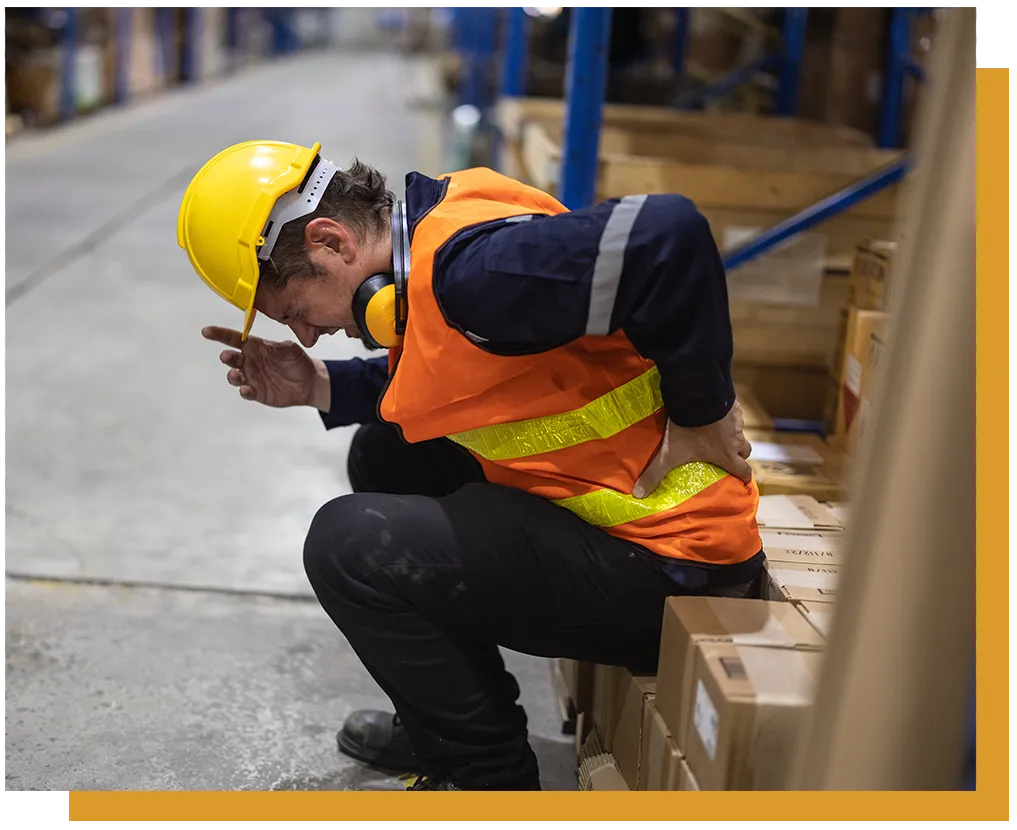
Generally no — workers’ compensation is your exclusive remedy against your employer. But California recognizes narrow exceptions that allow a civil suit directly against an employer:
- Uninsured employer (Labor Code § 3706) — if your employer illegally failed to carry workers’ compensation insurance, you may sue them in civil court, and several of their usual defenses are stripped away under section 3708.
- Power-press exception (Labor Code § 4558) — if you were injured because your employer knowingly removed or failed to install a manufacturer-required point-of-operation guard on a power press.
- Fraudulent concealment (Labor Code § 3602(b)) — if your employer knew of your injury, concealed it, and the concealment made it worse.
- Employer-manufactured defective product (Labor Code § 3602(b)(3)) — if your employer made a defective product, sold it to an independent third party, and that product was later provided for your use by a third party. California abolished the broader “dual capacity” doctrine in 1982.
The Privette Doctrine: When Can You Sue the General Contractor or Property Owner?
When you work for a subcontractor, a key question is whether you can sue the hirer — the general contractor or property owner who hired your employer. Under the Privette doctrine (Privette v. Superior Court (1993) 5 Cal.4th 689), a hirer is usually not liable to a subcontractor’s employees, because workers’ compensation is expected to cover them. Two important exceptions can open the door to a claim against the hirer:
- Retained control (the Hooker exception) — Hooker v. Department of Transportation (2002) 27 Cal.4th 198 allows a claim when the hirer kept control over the manner and means of the work and exercised that control in a way that affirmatively contributed to the injury — for example, by directing an unsafe method or overriding a safety decision.
- Concealed hazard (the Kinsman exception) — Kinsman v. Unocal Corp. (2005) 37 Cal.4th 659 allows a claim when the hirer knew of a hidden hazard the contractor could not reasonably have discovered — such as undisclosed asbestos, buried utilities, or a structural defect — and failed to warn.
The Privette doctrine and its exceptions are heavily litigated and often decide whether a serious case succeeds. Few construction pages address it, but knowing how California courts actually apply Hooker and Kinsman is frequently what separates a recovery from a dismissal.
Who Can Be Held Liable for a San Diego Construction Accident?
Beyond the workers’ compensation claim against your employer, a third-party claim may target any of the following:
- The general contractor, for unsafe site conditions or negligent supervision (subject to Privette)
- Another subcontractor or its employees whose negligence caused the accident
- The property owner, for dangerous conditions on the premises
- An equipment or parts manufacturer, for defective machinery, tools, or safety devices
- A materials supplier, engineer, or architect, where their negligence contributed
The OSHA “Focus Four” Construction Hazards
Federal OSHA and California’s Cal/OSHA identify four hazards — the “Focus Four” (or “Fatal Four”) — as the leading causes of construction deaths:
- Falls — the leading cause, responsible for roughly a third or more of construction fatalities.
- Struck-by-object — falling tools, materials, or equipment, and vehicle strikes.
- Electrocutions — contact with power lines, faulty wiring, and unguarded equipment.
- Caught-in/between — trench collapses and being caught in machinery.
California employers must follow Cal/OSHA safety regulations in Title 8 of the California Code of Regulations, including fall protection for elevated work. California has been aligning its residential-construction and roofing fall-protection trigger with the federal six-foot standard, and higher thresholds have historically applied to some other construction work. A Cal/OSHA citation issued after an accident can be powerful evidence of negligence in a third-party claim, and we routinely obtain and use these findings.
Common Construction Site Injuries
When an injury occurs on a construction site, the worker often needs emergency medical attention, may miss time from work, and may face costly medical expenses. In some construction site accidents, the injuries can be so severe that they are responsible for new disabilities or even death.
Examples of construction site and equipment injuries include the following:
- Amputations and loss of limbs or digits
- Back, neck, and shoulder injuries
- Broken bones and fractures
- Burns
- Cancer and other forms of disease or illness
- Crushing injuries
- Deep cuts, lacerations, and scarring
- Degloving injuries
- Dental injuries
- Dislocated joints
- Electrocution
- Eye injuries and vision loss
- Harmful exposure to toxic substances
- Heart attacks
- Internal bleeding and organ damage
- Knee injuries
- Loss of hearing
- Oxygen deprivation
- Post-traumatic stress disorder and other forms of mental health disorders
- Soft tissue injuries, including ligament and muscle tears
- Spinal cord injuries, which can sometimes result in complete or partial paralysis
- Strokes
- Traumatic brain injuries, open head wounds, and severe concussions
- Wrongful death
- And more
Even if you have only suffered relatively minor injuries, it is still worth speaking to our attorneys about the potential of filing a workers’ compensation claim or a personal injury lawsuit.
What Is the Statute of Limitations for a Construction Accident in California?

Two separate clocks run after a construction injury, and missing either can cost you a recovery:
- Workers’ compensation — report the injury to your employer within 30 days (Labor Code section 5400) and generally file your claim within one year (Labor Code section 5405).
- Third-party lawsuit — generally two years from the date of injury under Code of Civil Procedure section 335.1; six months to file an administrative claim if a government entity is involved (Government Code section 911.2).
Can I Recover if the Accident Was Partly My Fault?
Yes. Workers’ compensation is no-fault, so you receive benefits even if your own carelessness played a role. In a third-party lawsuit, California’s pure comparative negligence rule reduces your recovery by your percentage of fault but never eliminates it — so a partial mistake does not bar your claim.
Do Undocumented Workers Have Rights After a Construction Accident?
Yes. California law protects every worker regardless of immigration status. Under Labor Code section 1171.5, undocumented construction workers are entitled to workers’ compensation benefits and may bring third-party personal injury claims just like any other worker. An employer cannot use your immigration status to deny you benefits or defeat your claim, and we keep that information protected.
What to Do After a Construction Accident

Construction Accidents in San Diego: Local Considerations
San Diego’s construction boom — downtown high-rises, university and hospital expansions, freeway and transit projects, and residential development across North County and the South Bay — keeps thousands of workers on dangerous sites every day. Workers’ compensation disputes for the region are heard at the San Diego district office of the Workers’ Compensation Appeals Board, while third-party lawsuits are filed in the San Diego County Superior Court. If your construction claim was denied, we can challenge the denial before the Appeals Board. We represent injured construction workers and their families throughout the county, including Chula Vista, El Cajon, La Mesa, Oceanside, Carlsbad, Escondido, and San Marcos.
Frequently Asked Questions: Construction Accidents
Contact Our San Diego Construction Accident Lawyers Today

If you or someone you love has been injured in a construction accident, the team at Banker’s Hill Law Firm is ready to help. Call (619) 230-0330 or request a free case evaluation to speak with our San Diego legal team today. There are no upfront costs, and you owe no attorney fees unless we win.
About the Attorney: Maxwell C. Agha
Maxwell C. Agha is the founding principal of Banker’s Hill Law Firm, A.P.C. He earned his Juris Doctor from the University of San Diego School of Law in 1988 and has spent more than 36 years representing injured Californians in state and federal courts, recovering millions of dollars in settlements and verdicts. Because his firm handles both workers’ compensation and personal injury, he pursues the injured construction worker’s comp benefits and third-party claim together — including Privette, retained-control, and equipment-defect claims — to maximize the total recovery.
Mr. Agha has been recognized among the Top 100 National Trial Lawyers and the Top 50 of the National Bar Association, is a Lanier Trial Academy alumnus, and has been featured on CourtTV for his work on catastrophic personal injury cases. He serves as an active arbitrator for the San Diego County Bar Association and is a member of the American Bar Association, San Diego County Consumer Attorneys, the Lawyers Club of San Diego, and the Earl B. Gilliam Bar Association.
Banker’s Hill Law Firm holds a 4.8-star rating across more than 430 client reviews, and our multilingual team assists clients in English, Spanish, Mandarin, Cantonese, Lao, Cambodian, and Arabic. Every personal injury and workers’ compensation case is handled on a contingency-fee basis — you pay no attorney fees unless we recover compensation for you.
To learn more about the benefits of retaining our legal representation, please contact our California construction accident attorneys to schedule your initial consultation today. Our law office can be reached at (619) 230-0330.