
 (619) 230-0330


Key Takeaways
- Yes. Lane splitting is legal in California. No law prohibits it, and Vehicle Code § 21658.1 defines it and lets the California Highway Patrol (CHP) publish safety guidelines.
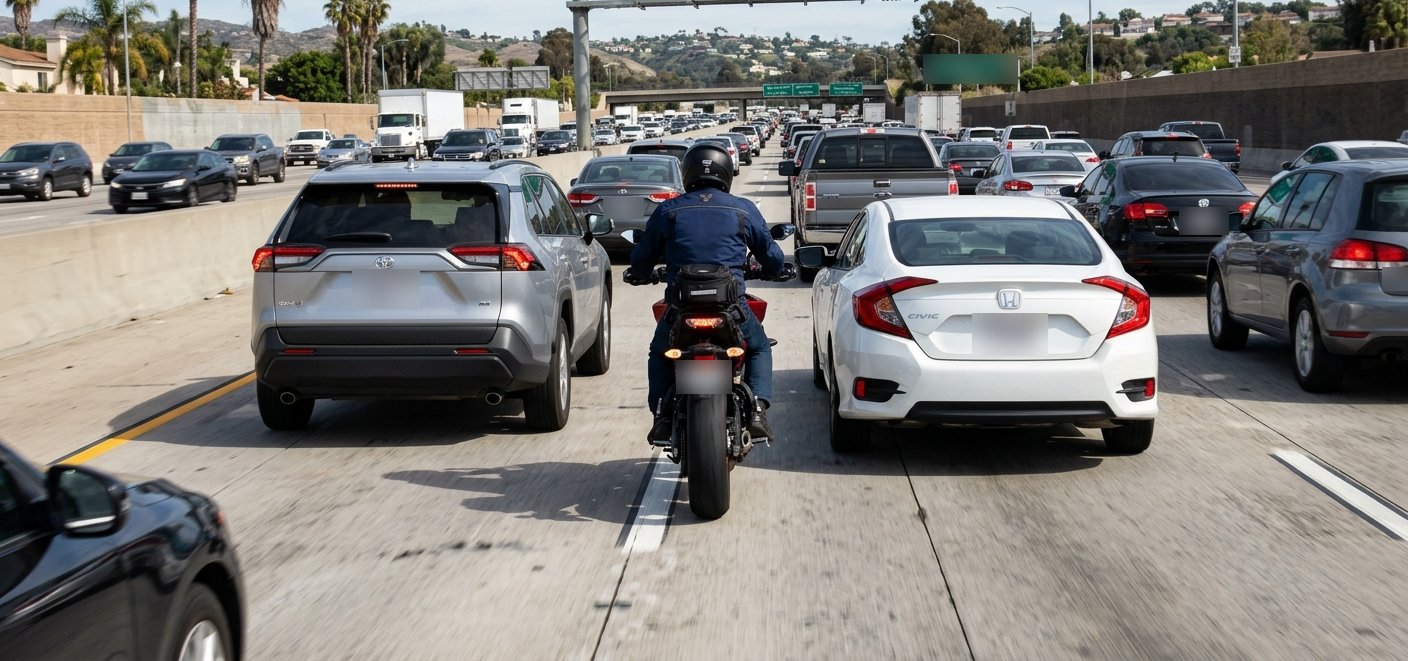
- The definition covers a two-wheeled motorcycle riding between rows of stopped or moving vehicles in the same direction. Riding on the shoulder is not lane splitting, and it is illegal.
- There is no set speed limit for lane splitting. The basic speed law still applies, and CHP warns that danger rises with speed and with the speed difference between the rider and traffic.
- Drivers may not intentionally block or impede a lane-splitting rider in a way that could cause harm, and opening a door into traffic is illegal.
- Lane splitting does not make a rider automatically at fault. Under California’s pure comparative fault rule, any share of fault reduces a rider’s recovery but does not bar it.
- You generally have two years to file an injury lawsuit (Code Civ. Proc. § 335.1), and six months for a claim against a government agency (Gov. Code § 911.2).
Yes, lane splitting is legal in California. No state law prohibits a motorcyclist from riding between lanes of slow or stopped traffic, and since 2017 the Vehicle Code has defined the practice and authorized the CHP to publish guidelines for doing it safely. The rider must still ride at a safe speed and change position only when it is safe.
That legal status matters most after a crash. Insurers often treat a lane-splitting rider as the one to blame. California law does not.
What California law says about lane splitting
Vehicle Code § 21658.1 defines lane splitting as driving a motorcycle that has two wheels in contact with the ground between rows of stopped or moving vehicles in the same lane, on divided and undivided roads and highways. It allows the CHP to develop educational safety guidelines, in consultation with the DMV, Caltrans, the Office of Traffic Safety and a motorcycle safety organization.
In short: lane splitting is legal in California because no law prohibits it, and Vehicle Code § 21658.1 defines it and authorizes the CHP to issue safety guidelines.
- It does not say “legal” in so many words. Lane splitting was never banned in California. Assembly Bill 51 added § 21658.1 effective January 1, 2017, and the CHP’s message to drivers states plainly that lane splitting by motorcyclists is legal.
- It sets no speed limit. The statute has no maximum speed or speed difference.
- It covers only two-wheeled motorcycles. The general definition of a motorcycle (§ 400) includes some three-wheelers and sidecar rigs, but the lane-splitting definition requires two wheels on the ground.
Lane splitting, lane filtering and riding the shoulder
California’s statute uses only one term. Here is how each common move fits:
| Move | What it means | California status |
|---|---|---|
| Lane splitting | Riding between rows of moving or stopped vehicles traveling in the same direction | Legal; defined in Veh. Code § 21658.1. Speed and safe movement rules still apply |
| Lane filtering | Moving between stopped cars, often to the front at a red light | Not a separate term in California law. Riding between rows of stopped vehicles fits the § 21658.1 definition |
| Riding the shoulder | Passing traffic on the paved shoulder or off the main roadway | Illegal. The CHP says it is not lane splitting, and passing on the right may never be done by driving off the paved or main-traveled roadway (Veh. Code § 21755) |
| Trike or sidecar between lanes | A three-wheeled machine, or a bike with a sidecar, moving between rows | Outside the § 21658.1 definition, which covers only motorcycles with two wheels on the ground |
What the CHP’s lane-splitting safety tips say
The CHP publishes its current guidance on its California Motorcyclist Safety page. It opens with a disclaimer: lane splitting can be dangerous, it should not be done by inexperienced riders, and the risk of death or serious injury rises as speed and speed difference increase. The tips themselves tell riders to:
- Consider the whole environment, including lane width, the size of nearby vehicles, and road, weather and lighting conditions.
- Remember that danger increases at higher speed differences and higher overall speeds.
- Split between the far left lanes, which is typically safer than splitting between other lanes.
- Avoid splitting next to large vehicles such as big rigs, buses and motorhomes.
- Stay out of other vehicles’ blind spots and avoid lingering between vehicles.
- Wear brightly colored or reflective gear and use high beams during daylight.
The tips are guidance, not statute, and carry no numeric limit. Some older articles still quote speed numbers the CHP no longer publishes, so if an adjuster cites a “rule” with a number in it, ask where it comes from. In a claim, the question is whether the rider acted reasonably under the conditions.
Rules that still apply to a lane-splitting rider
Legal does not mean anything goes. Breaking one of the ordinary rules of the road is what turns a legal maneuver into a fault argument:
- The basic speed law. No one may drive faster than is reasonable or prudent for the weather, visibility, traffic and road conditions (Veh. Code § 22350).
- Safe lane movement. A vehicle must stay as nearly as practical within a single lane and may not move from it until it can do so with reasonable safety (Veh. Code § 21658(a)). A rider who darts out of a gap breaks this rule as surely as a driver does.
- Signals. No one may move right or left on a roadway until it is reasonably safe, and only after signaling when another vehicle may be affected (Veh. Code § 22107).
- Reckless driving. Riding with willful or wanton disregard for safety is reckless driving (Veh. Code § 23103).
- Helmets. Every rider and passenger must wear a helmet that meets state safety requirements (Veh. Code § 27803). See our guide to recovering damages after a crash without a helmet.
What drivers must do around lane-splitting riders
Drivers have duties too. The CHP’s message to other drivers says that intentionally blocking or impeding a motorcyclist in a way that could cause harm is illegal, that opening a vehicle door to impede a motorcyclist is illegal, and that drivers in the far left lane should move to the left side of their lane to give riders room to pass. The Vehicle Code also bars opening a door on the traffic side unless it is reasonably safe and does not interfere with moving traffic (Veh. Code § 22517).
More often, the driver simply changes lanes in slow traffic without checking a mirror or blind spot. That driver is bound by the same safe-movement and signal rules (§§ 21658(a), 22107).
Who is at fault in a lane-splitting accident?
Fault depends on what each person did, not on where the motorcycle was. Because lane splitting is legal, it is not negligence by itself, and an insurer cannot treat the rider as automatically at fault.
| What happened | Who is usually responsible | Rules that apply |
|---|---|---|
| Driver changes lanes into a rider already between lanes | Mainly the driver, who moved without making sure it was safe | Veh. Code §§ 21658(a), 22107 |
| Door opened into a rider passing stopped traffic | The person who opened the door | Veh. Code § 22517 |
| Driver swerves or closes a gap to block a rider | The driver | CHP: intentionally blocking or impeding a rider in a way that could cause harm is illegal |
| Rider splits far faster than traffic in poor conditions | Fault may be shared; the rider’s share depends on speed and conditions | Veh. Code § 22350 (basic speed law) |
| Rider passes on the shoulder | The rider likely bears a larger share, since shoulder passing is illegal | Veh. Code § 21755 |
How comparative fault works
California uses pure comparative fault, adopted by the California Supreme Court in Li v. Yellow Cab Co. (1975) 13 Cal.3d 804. If a jury finds you partly at fault, your damages are reduced by your percentage of fault, but you can still recover. A rider found 20% at fault for splitting too fast recovers 80% of their damages; the driver who made the unsafe lane change pays that share. Our guide to how comparative fault works in California covers the rule in more depth.
A legal presumption can also matter. Under Evidence Code § 669, someone who violates a safety statute and causes the kind of harm it was meant to prevent is presumed negligent, though the presumption can be rebutted. A driver’s unsafe lane change can trigger it. Lane splitting alone cannot, because it violates no statute.
How insurers use lane splitting against riders, and what answers it
Adjusters know many people still think lane splitting is illegal, and they lean on that belief: blaming the rider in the first call, asking for a recorded statement about speed, and pairing lane splitting with helmet or speed arguments to push the rider’s percentage up. Evidence answers those arguments:
- Video. Dashcams, helmet cameras and nearby businesses can show where the bike was and when the car moved. Footage is often overwritten quickly, so ask for it early.
- Witnesses. Drivers stopped in traffic often saw the lane change.
- Vehicle damage. Where the bike and car were struck shows who moved into whom.
- The police report. A driver’s statement that they “never saw” the rider supports a failure to check before changing lanes.
Talk with a lawyer before giving the other driver’s insurer a recorded statement. Our San Diego motorcycle accident guide covers the full list of steps after a crash.
Deadlines and insurance rules that affect your claim
- Two years to sue. Most injury lawsuits must be filed within two years of the crash (Code Civ. Proc. § 335.1).
- Six months for government claims. If a city, county, state agency or public vehicle was involved, a written claim usually must be presented within six months (Gov. Code § 911.2).
- Carry insurance on your bike. An uninsured vehicle owner, or a rider who cannot show the financial responsibility the law requires, generally cannot recover non-economic damages such as pain and suffering in a crash claim, with limited exceptions (Civ. Code § 3333.4).
Riders often ask how long the claim itself will take. The stages are similar to a car claim; see how long a car accident settlement takes in California.
What to do after a lane-splitting crash in San Diego
- Get medical care right away, even if you feel fine.
- Call the police and give the facts without guessing at your speed.
- Photograph the bike, the car, lane markings and the traffic around you.
- Collect names of witnesses and the other driver’s insurance information.
- Save your gear and footage. Do not repair the bike or discard a damaged helmet before it is documented.
- Write down what traffic was doing and which lanes you were between.
If you were hurt while splitting lanes on I-5, I-805, I-15 or any San Diego freeway, our San Diego motorcycle accident lawyers can review how fault is likely to be argued in your case.
Frequently asked questions
Talk to a San Diego motorcycle accident lawyer
Banker’s Hill Law Firm has represented injured people across San Diego County since 1991. Maxwell Agha, who has practiced law in California for more than 35 years, and our team handle lane-splitting, left-turn and unsafe lane-change crashes, in English or Spanish. Learn more about our personal injury practice or our work as a San Diego motorcycle accident lawyer.
There are no upfront costs, and you owe no attorney fees unless we win.
For a Free Evaluation, call (619) 230-0330 or contact our San Diego office. We also serve riders in Chula Vista and the South Bay.
This article is general information about California law and is not legal advice. Reading it does not create an attorney-client relationship. How fault is divided after a crash depends on the facts, so speak with an attorney about your situation.